Author Archive

Conversations about conservation: public participation in scientific research

By Anne Toomey April 14th, 2011 at 12:04 pm | Comment

TagCloudTitle

Energy is a strange thing.  It floats around you, fills you up until you’re about ready to burst, and then it skips off, leaving you to keep up as best you can.  Last Thursday and Friday were two full days of such energy, when 60 professionals from such exotic places as Alaska, Colombia and New Jersey got together to discuss why and how public participation in scientific research (PPSR) is necessary if we are to save the world’s biodiversity.  The amazing thing about this workshop wasn’t so much that these people had a similar goal (after all, who doesn’t want to save the world?), but rather that the participants brought such a diversity of backgrounds, academic disciplines and institutions to the table.

Although the participation of citizens in scientific research goes back centuries, it is only very recently that there has been a push and pull from many different areas, leading to an amazing expansion of this kind of research and a demand for new ideas, ways to engage, and methods to understand how and why this can ultimately lead us forward in conservation.  The 50+ projects that were represented during this workshop illustrated this expansion not only by what they had in common – citizen engagement, data collection, and links to better conservation management – but also by what they didn’t.  While some projects, like FrogWatch USA or Monarch Larva Monitoring Project, invite participants from across the United States to collect data on a wide geographical scale, other projects such as Ndee bini’ bida’ilzaahi (Pictures of Apache Land) and the Fresno Bird Count are place-specific, uniquely adapted to the needs of their local community and natural environment. Read the rest of this entry »

The importance of thinking scientifically

By Anne Toomey April 1st, 2011 at 3:34 pm | Comment 1

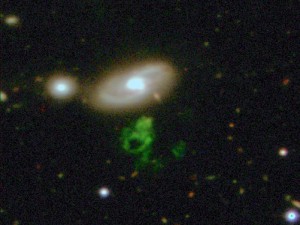
Dutch schoolteacher Hanny van Arkel, discovered the strange green "voorwerp" (Dutch for "object") in 2007. (Photo: NASA)

Dutch schoolteacher Hanny van Arkel, discovered the strange green "voorwerp" (Dutch for "object") in 2007. (Photo: NASA)

What does it mean to think scientifically?

If you asked me this question when I first moved back to New York three years ago, I’m quite positive I would have said something like, “What do I know? I’m not a scientist,” and pointed the questioner in the direction of the nearest pocket-protecting nerd in the vicinity.

Science was never one of my best subjects (I can still remember my high school physics teacher, Dr. Moroni, speeding out of the parking lot in his Pontiac Aztek to avoid telling me that I had failed the final exam). In fact, it was the very last thing I thought I would get involved in upon settling into my artsy Brooklyn neighborhood in 2008 to write my first novel. However, since my discovery of citizen science through the Earthwatch Institute and WildMetro, I now consider myself an unofficial member of the super hip NYC science community, whose events on such sexy topics as the dark matter and neuroscience are more likely to be full of trendy 30-somethings sipping beer out of plastic cups than pale, lab coat wearing individuals with microscope indentations around their eyes.

To begin a journey into the realm of the scientific mind, let’s go back in time about 177 years ago, when the word “scientist” first appeared in the Oxford English Dictionary. Before this transitional moment in human history, people we would now think of as scientists were called “natural philosophers” – those who studied the workings of nature. Some of these philosophers, such as Anton van Leeuwenhoek and Michael Faraday, had little formal training in their chosen subjects, but came to learn about science through a personal desire to come up with answers to their individual questions about the universe. Science was less a profession or an academic field as it was a way of thinking about the world and understanding its mysteries through direct observation.

In some ways, the study of science was more accessible two hundred years ago than it is in today’s science classrooms, where students are typically tested on their ability to remember the answers to hundreds of questions that have already been answered, rather than being encouraged to look up at the sky or at a blade of grass and come up with questions of their own.

Read the rest of this entry »

The first step for citizen scientists: enjoying nature

By Anne Toomey March 9th, 2011 at 4:54 pm | Comment

To swing, or not to swing...

Sometimes you just have to get started...

During the past week, I’ve experienced nature from a state of semiconsciousness in my bed. Almost every morning, the same lonely male cardinal practices his songs for spring, occasionally interrupted by a pair of blue jays imitating a hawk or a small flock of monk parakeets flying overhead from their nests.

There’s something special about doing citizen science from your bedroom with your eyes closed – even if I have yet to find a project that will accept data that is taken while you’re half-asleep.

A couple of days ago, I had a brilliant idea: citizen science from the comfort of my bed! I can count the stars, peer through my window at birds (which has the additional benefit of freaking out the neighbors), and measure snow accumulating on my fire escape – all without experiencing the February cold!

I tried this for a couple of hours one morning, attempting to conduct as many scientific experiments as possible from my 8×4 foot bedroom. Yet, something was missing from the experience. I found myself getting bored and my mind floating between the unread emails in my inbox and the uneaten chocolate in the refrigerator. So, the next morning, I threw on some warm clothes, filled up a travel mug with hot coffee, and headed over to Prospect Park to figure out what was missing.

Read the rest of this entry »

How citizen science will save the planet

By Anne Toomey February 18th, 2011 at 3:47 pm | Comment 1

Anne Toomey will be starting a Ph.D. in citizen science this fall.

Anne will be starting a Ph.D. this fall to study citizen science as a tool for conservation.

Ponder for a moment this quote written by Aldo Leopold in the late 1940s:

“We can be ethical only in relation to something we can see, feel, understand, or otherwise have faith in.”

Food for thought, especially if you are a citizen scientist like I am. And even more so if you are a citizen scientist who cares about the environment and believes deep down that citizen science just may save the planet. But who am I to come up with such crazy theories? Hmm, I suppose this calls for an introduction…

My name is Anne, La Señorita Toomey, citizen science aficionado and lover of all things natural. I’m so into citizen science that I’m actually embarking upon a Ph.D. program in the fall to study citizen science as a tool for conservation in one of the most biodiverse places on the planet, Madidi National Park in Bolivia. In the meantime, I’m spending my days – and some insomnia-ridden nights – thinking about how and why citizen science is likely to become the most important discovery for the environmental movement in the 21st century.

With the promise of solar energy, hydrogen-powered cars, and molecule transporters (okay, so that last one is on my fantasy wish list), citizen science may sound like a hokey solution to the incredible array of environmental challenges we are currently facing. But if we look deeper into the meanings of science and citizenship, we realize that encouraging non-experts to participate in the building of knowledge about how our world works may have profound implications for the way we, as a global community, will relate to our natural environment.

Read the rest of this entry »